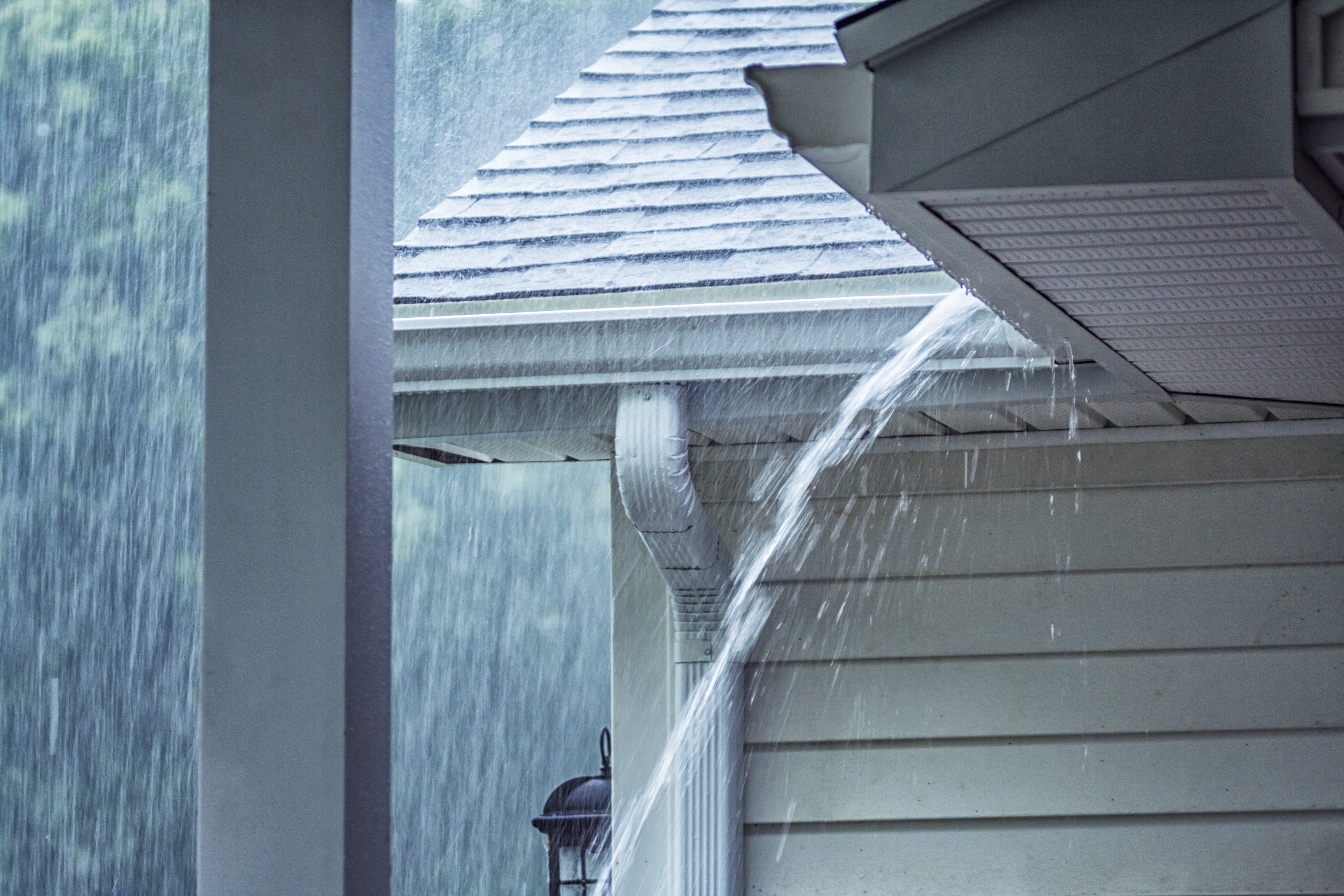
Spring has a way of arriving with drama. After months of frozen ground and dormant landscaping, the first heavy rainstorms of the season hit homes that have been sitting through ice, wind, and temperature swings — and those homes are rarely as ready as their owners assume.
Most homeowners picture rain damage as something that happens all at once: a dramatic leak, a waterfall down the wall, a ceiling stain that wasn't there yesterday. In reality, water intrusion is almost always a slow process. It begins at specific weak points, works its way through layers of material over time, and by the time you notice it inside, it's been building momentum for weeks — sometimes longer.
Understanding where water actually goes during a heavy spring rainstorm is the first step toward protecting your home from the damage it leaves behind.
How Water Moves Around Your Property
When rain falls hard and fast, the ground can only absorb so much. The rest becomes runoff, and that runoff follows the path of least resistance — which, ideally, leads away from your foundation. Whether that actually happens depends entirely on your property's grading.
Grading refers to the slope of the soil around your home's perimeter. The standard recommendation is a drop of at least six inches over the first ten feet away from the foundation. When grading is correct, water flows outward toward the yard. When it's settled, eroded, or was never properly established, it slopes inward — and that means every heavy rain is pushing water toward your basement or crawlspace walls.
This is one of the most overlooked vulnerabilities in residential homes. Homeowners will spend thousands waterproofing a basement without ever addressing the grading that's directing water toward it in the first place.
The Gutter System: Movement, Blockage, and Overflow
Gutters are your home's first line of defense against roof runoff, and spring is when they're most likely to fail. Winter deposits leaves, twigs, seed pods, and compacted debris that blocks water from flowing freely. When a spring storm dumps two inches of rain in an hour, a clogged gutter doesn't just overflow — it overflows in exactly the wrong direction: straight down the side of your house.
Water cascading off a blocked gutter saturates the soil directly against your foundation, works behind exterior siding, and begins to rot the fascia boards and soffit that the gutter is attached to. Downspouts that terminate too close to the foundation compound the problem. Most contractors recommend extending downspout discharge at least four to six feet from the structure.
Gutters also pull away from the fascia over time, especially after ice dam cycles. Even a slight separation creates a gap where water runs behind the gutter rather than through it — invisible to the casual eye, but quietly soaking wood and siding every time it rains.
Siding: Where the Exterior Shell Lets Water In
Siding is designed to shed water, not to be waterproof. The real protection sits behind it — a layer of housewrap or building paper that blocks moisture from reaching the sheathing. When that system is compromised, water finds its way in.
Common siding failure points include:
- Caulk joints around windows, doors, and utility penetrations that have cracked or shrunk with age
- Lapped seams that have separated or been damaged by impact
- Gaps at the base where siding terminates, especially if it sits too close to grade or decking
- Flashing failures at intersections between siding and rooflines, chimneys, or additions
Water entering behind siding doesn't always show up immediately indoors. It can travel downward inside the wall cavity, rotting sheathing, saturating insulation, and promoting mold growth — all before a single interior stain appears.
The Roof: Where Most Problems Actually Begin
Of all the surfaces a spring rainstorm hits, the roof takes the hardest punishment. Wind-driven rain can force water upward under shingles. Ponding from debris-blocked drainage sits for hours. And years of freeze-thaw cycles have already done quiet damage to underlayment, flashing, and sealants that looked fine from the ground last fall.
The most critical weak points on a roof include:
Flashing. The thin metal strips that seal transitions — where a chimney meets the roof, where a dormer intersects with the main slope, where different planes come together — are the number one entry point for water. Flashing relies on proper overlap, sealant, and tight attachment. All three degrade over time, and even a small gap allows water to wick underneath during heavy rain.
Valleys. Where two roof planes meet, water from both slopes converges and accelerates. High-volume flow puts more pressure on the valley liner, and if it's compromised, water moves laterally under adjacent shingles.
Pipe boots and penetrations. Every plumbing vent, exhaust pipe, or conduit that exits through the roof has a rubber boot around it. Those boots crack and harden as they age, creating gaps that few homeowners ever inspect.
Ridge and hip caps. The topmost shingles on a roof take the brunt of wind and UV exposure. When they begin to lift or lose their granular coating, they become the easiest path for wind-driven rain to get beneath.
What a Roofing Inspection Actually Catches
Many of the vulnerabilities described above are genuinely difficult for homeowners to assess. Getting on a wet roof is dangerous, and the damage often isn't visible from the ground. Working with a local roofing company in Lincoln for asphalt shingles means having someone who can read the early signs — granule loss in the gutters, soft spots in the decking, micro-cracks in flashing sealant, and lifting shingles at the edges — before any of it turns into an interior leak.
A professional inspection before storm season, or immediately after a major rain event, can catch problems at the stage where a targeted repair costs hundreds rather than thousands. The goal isn't to find reasons to replace a roof. It's to know exactly what you're working with so that when the next storm rolls through, you're not caught off guard.
The Pattern Worth Understanding
Heavy spring rainstorms don't create problems from scratch. They expose problems that already exist — in grading that's shifted, gutters that haven't been cleaned, caulk that dried out over the winter, and flashing that was never quite right to begin with.
Water is patient. It doesn't need a large opening. It needs a path, and it will find one given enough time and enough rain. The homeowners who avoid the most expensive repairs aren't the ones who react fastest after damage shows up indoors — they're the ones who understand how water moves and address the vulnerabilities before a storm has the chance to find them.
Spring is both the riskiest season for water intrusion and the best time to do something about it. The rain will come regardless. What matters is whether your home is ready for it.