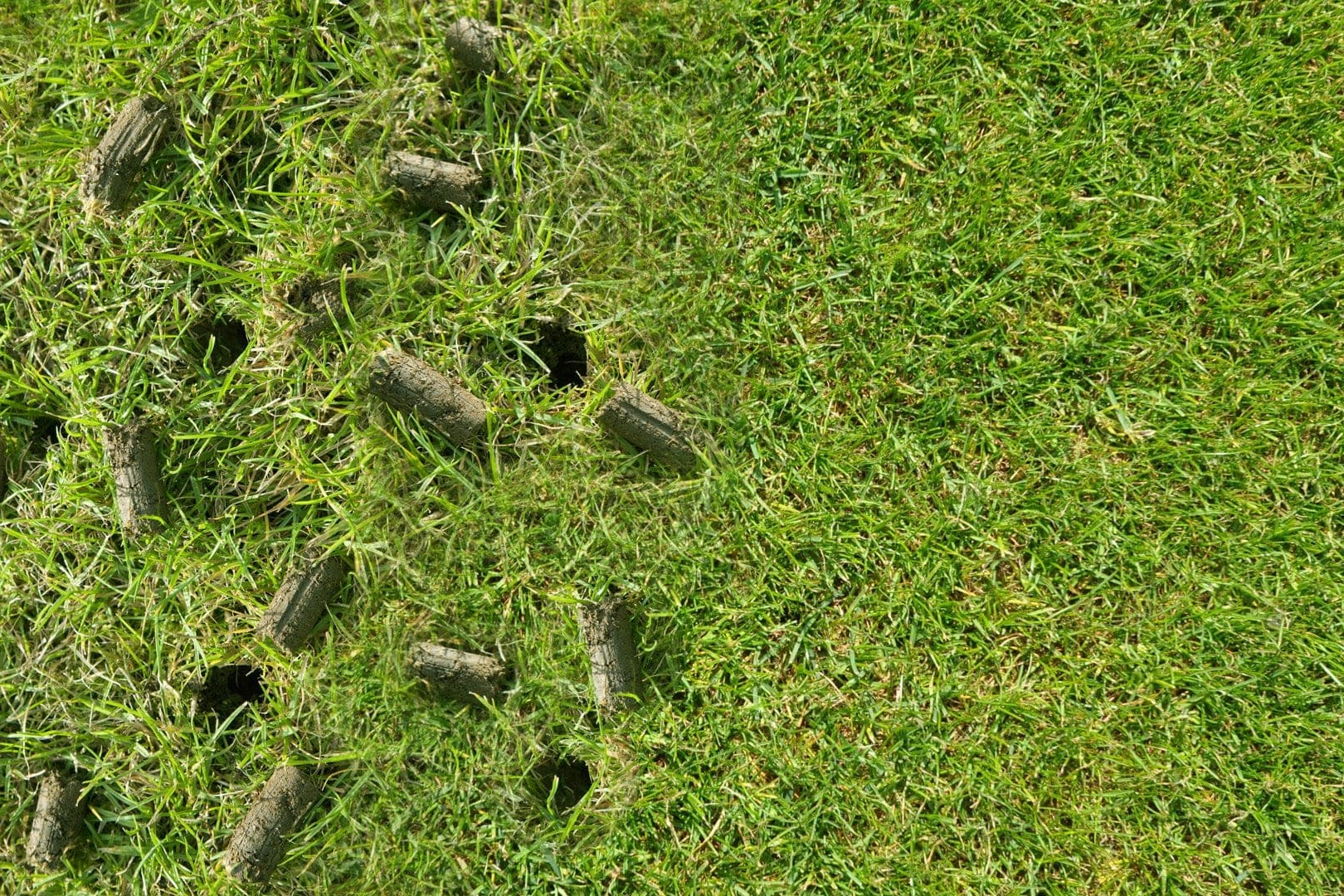
You rented the machine, dragged it across the yard, and now your lawn looks like a flock of geese held a meeting on it. Little plugs of soil everywhere. Holes the size of your finger. And the question every single person asks at this exact moment is the same: how long until it looks normal again?
Here's the honest answer nobody wants to give you. It depends almost entirely on something you decided before you ever started the machine.
Most articles will tell you "two to four weeks" and move on. That number isn't wrong, exactly. It's just useless on its own, because it assumes your grass is growing. And whether your grass is growing is the whole ballgame.
The calendar is lying to you
The reason "two to four weeks" gets repeated everywhere is that it's true for a lawn caught in its active growing season. Roots are pushing, the plant is hungry for oxygen and water, and the holes you just punched are exactly what it wanted. Under those conditions, the surface plugs break down in one to two weeks, and the holes themselves close over the following few weeks as the turf thickens.
Now aerate the same lawn when it's dormant. Nothing happens. The holes sit open. The plugs dry out and crumble, but the gaps don't fill, because the plant isn't building anything. Three weeks pass, and your lawn looks exactly as beaten-up as day one.
So the recovery clock doesn't start when you pull the plugs. It starts when your grass is actually growing. That's the thesis of this whole piece, and once you see it, every other decision gets easier.
Your grass type is the real stopwatch
This is where it gets practical, and where most people go wrong.
Lawns fall into two camps with opposite schedules. Cool-season grasses (think fescues, ryegrass, Kentucky bluegrass) do their serious growing in spring and early autumn. Warm-season grasses (buffalo, couch, kikuyu, zoysia) shut down when it's cold and roar to life in the warmth.
Aerate in the wrong window for your type, and you're not helping the lawn. You're handing weeds an engraved invitation. Open holes in a lawn that can't grow into them become, in the words of one turf guide, weed real estate.
There's a second layer underneath the grass type, and it's the one that separates a lawn that fills in fast from one that limps. A healthy, climate-appropriate lawn recovers faster than a stressed or poorly-matched one, full stop. Turf that's already acclimatised to its local conditions, the kind a grower like A View Turf cultivates for a specific regional climate, comes into aeration with the root vigour to colonise those holes quickly. Grass that's fighting its environment spends its energy just surviving, and recovery drags.
The University of Maryland Extension puts the warm-season window at roughly late spring to mid-summer, when those grasses are growing vigorously, and is blunt about the rule: never aerate a dormant lawn. For cool-season lawns, Iowa State University Extension names spring and early autumn as the recovery-friendly windows.
Here's the quick read on timing by type:
|
Grass type |
Aerate when... |
What recovery feels like |
|
Warm-season (buffalo, couch, kikuyu) |
Soil is warm and the lawn is growing hard |
Fast once timed right; plugs gone in ~2 weeks, holes closing within a month |
|
Cool-season (fescue, rye, bluegrass) |
Spring or early autumn, soil moist not cold |
Steady through the cool growing weeks; pairs naturally with overseeding |
|
Either type, but dormant |
Don't |
Holes sit open, weeds move in, no real recovery |
What's actually happening in those first 14 days
Picture the hole as a tiny construction site. The plant senses the opening, sends roots laterally and downward into the loosened, oxygen-rich soil, and starts thickening from the edges in. That's the recovery. The cosmetic stuff on the surface, the crumbling plugs, is just the rubble being cleared.
This is why the first two weeks decide everything, and why a few well-meaning instincts will wreck them.
Don't reach for weed killer. Fresh aeration holes make the lawn more chemically sensitive, and if you've seeded anything, a pre-emergent will stop it dead. Wait until the lawn shows it's recovering before any weed treatment goes down.
Don't let it dry out. Those open holes lose moisture fast, especially in heat, and dry soil at the hole walls slows root colonisation. Keep it consistently moist, not soggy.
And keep the traffic off. Kids, dogs, the wheelbarrow you swore you'd return to the shed. Compaction is the exact problem you just spent an afternoon fixing.
The one move that doubles your return
If aeration has a secret, it's this: the open hole is the best seedbed you will ever get, and it's only open once.
I watched this land for a neighbour who'd aerated and reseeded the same patchy strip three years running with mediocre results. The difference the year it finally worked wasn't the seed or the fertiliser. It was timing. He spread the seed the same afternoon he aerated, before the holes had a chance to dry or close, and ran a light top-dressing of screened compost over the top. Maximum seed-to-soil contact, seed sitting down in moist soil instead of perched on dry thatch. He had green shoots inside ten days and full coverage on the thin areas by week six.
Maryland Extension clearly supports the mechanism: aerating before overseeding creates holes for seed to fall into, increasing seed-to-soil contact. The window is short. Seed that goes down a week later lands on holes that have already started to close. Same seed, fraction of the result.
If you're not seeding, the equivalent move is feeding into the recovery. Iowa State recommends fertilising about a week before aeration and watering after if the weather's dry, so the plant has fuel ready when those holes open up.
A note on doing the job right while you're at it: a proper core aerator pulls plugs roughly three-quarters of an inch across and a couple of inches deep, and you're aiming for 20 to 40 holes per square foot, which usually means more than one pass. Skip anything with solid spikes. Spikes punch holes by compressing the soil around them, which makes compaction worse, not better.
How to tell it's actually recovered
Don't trust your eyes at the surface. The plugs breaking down and the lawn looking tidy again is cosmetic. It can happen in a week or two and tell you nothing about whether the holes have filled.
Real recovery is the holes closing over and the turf knitting back into a continuous surface. Push your fingers into the lawn where a hole was. If the soil's firm and the canopy has grown across it, you're there. If you can still feel an open pocket, the plant is still working, regardless of how green the top looks.
And if it's been a month with no real closing? That's your evidence that you aerated outside the growth window. File it away for next year, because the fix isn't more after-care. It's better timing.
Which brings the whole thing full circle. People treat aeration like a procedure with a fixed recovery time, the way a cut heals in a predictable number of days. It isn't. It's more like planting at the right moon. Do it when the conditions are with you and the lawn does the work itself. Do it when they're against you, and there's no amount of watering, feeding, or fussing that makes up the difference.
So the next time you're standing over a freshly punched lawn, wondering how long, flip the question. Don't ask how long recovery takes. Ask whether your grass is ready to start.