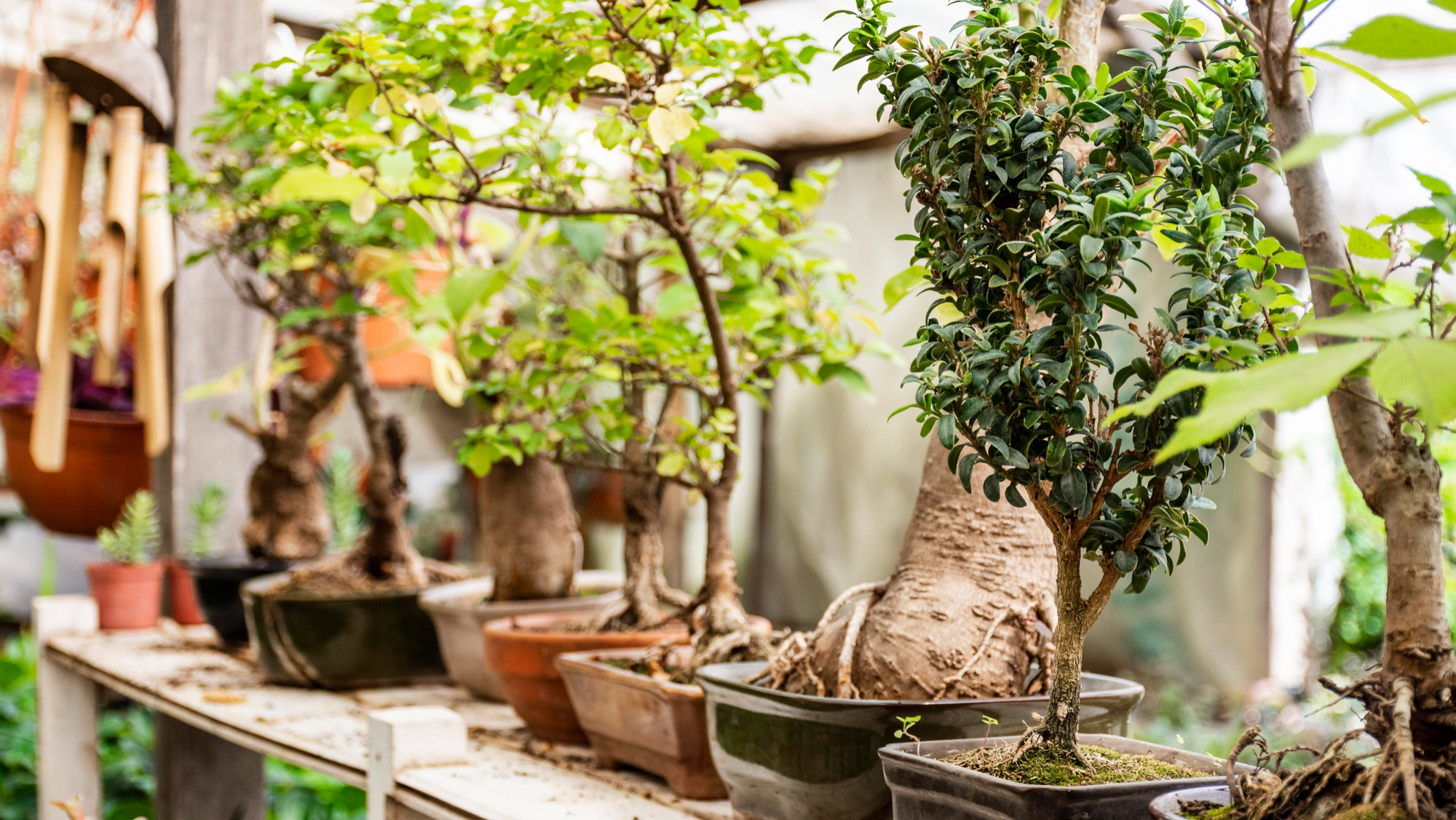
I built my first proper bonsai corner against the south wall of an old farmhouse in Calabria, more out of necessity than design. I had too many trees and nowhere sensible to keep them. What surprised me was how much better they grew once they had a real home: a spot with the right light, decent surfaces underneath, and a bit of shelter from the worst of the summer.
A Mediterranean bonsai corner is not a Japanese garden in miniature, and it should not try to be. It is its own thing, built around the plants, the stone, and the light that already belong to the south of Italy and the wider Mediterranean. Done well, it feels like it grew out of the place rather than being dropped on top of it.
You do not need much space. A two-metre stretch of wall, a few stands at different heights, and a handful of well-chosen trees are enough. What matters more is getting the basics right from the start, because a bonsai corner is something you live with for years.
Pick the spot before you pick the trees
Most people do this backwards. They buy the olive first and then look for somewhere to put it. In a hot climate the position decides almost everything, so it comes first.
I look for a spot that gets full morning sun and some relief in the afternoon. In the south, the August sun from midday onwards is brutal. It scorches foliage, cooks the roots inside small pots, and dries the substrate faster than you can keep up with. A wall facing south-east is close to ideal: strong light early, a little shade later.
Air matters too. Bonsai want moving air around the canopy, but not the dry, relentless wind we get on exposed terraces in summer, which desiccates the leaves and empties the pots. A corner partly enclosed by a wall on one side gives you light without turning the whole thing into a wind tunnel.
Choose species that actually belong here
This is where a Mediterranean corner earns its name. Instead of fighting the climate with trees that resent the heat, work with species that have lived in it for thousands of years.
The olive (Olea europaea) is the obvious starting point, and rightly so. It tolerates heat and drought, takes hard pruning, and develops a gnarled, ancient-looking trunk faster than almost anything else. The Royal Horticultural Society recommends full sun and sharply drained soil for olives, which is more or less what a bonsai pot in a sunny corner gives them anyway. An old olive in a simple pot is, to my eye, the most honest bonsai you can keep in southern Italy.
After that I would look at pomegranate (Punica granatum), with its red flowers and twisting bark, and myrtle (Myrtus communis), which clips into dense pads and smells of the maquis. The junipers are worth a place too, especially Juniperus sabina, which handles our summers and gives you that dramatic deadwood over time. Mediterranean buckthorn, holm oak, and even a well-kept rosemary all fit the spirit of the thing.
One piece of advice that saves a lot of grief: mix species that share the same needs. Putting a sun-loving olive next to something that wants constant moisture means one of them is always unhappy. A corner where everything thrives in the same conditions is far easier to keep alive.
Let stone and terracotta set the mood
The Mediterranean look comes from materials more than ornaments. I keep mine simple: unglazed pots in earth and stone tones, a bit of rough rock, and gravel underfoot. No bright glazes, no ceramic figurines, nothing that pulls the eye away from the trees.
Terracotta and muted, matte-glazed pots suit Mediterranean species and the colours around them. They also breathe, which helps the substrate dry between waterings. That is useful for olives and junipers, which hate sitting wet. A few pieces of tuff or lava rock placed low, with some creeping thyme or a small succulent at the base, tie the planting to the ground.
For the surfaces, I like a bed of pale gravel or crushed stone under the stands. It reflects a little light, keeps mud off the pots when you water, and gives the corner that dry, sun-bleached feel you see in old courtyards across the south. A weathered stone slab or a low wall as a backdrop does more than any decoration could.
If you want a reference for how Mediterranean trees are grown and presented properly, this collection of bonsai in Italy is close to the look I am describing here.
Build it in layers and at different heights
A row of pots all on the same bench looks like a shop display, not a corner. Height is what turns a collection into a composition.
I use stands, low tables, and a couple of taller plinths so the trees sit at different levels. The largest, heaviest tree usually goes lower and slightly to one side as an anchor. Smaller and more delicate trees go higher, where you see them at eye level. Leave gaps. The empty space around a tree is part of how you read it.
Think about how you move through the corner, too. You want to be able to reach every pot to water and turn it, and you want a place to stand back and actually look. I keep a small stone bench nearby for exactly that. Half the pleasure of a bonsai corner is sitting with it in the evening, when the heat finally breaks.
Watering and feeding in a hot, dry climate
This is the part that catches people out. A Mediterranean corner is gorgeous, but in July and August it asks for attention every single day.
I water in the early morning, before the sun is on the pots. The substrate in a small bonsai pot dries astonishingly fast in southern heat, and terracotta speeds that up further. On the worst days some trees need a second check in the evening, once the pots have cooled. I avoid watering at midday onto hot soil whenever I can.
A free-draining substrate helps more than it seems to. It sounds backwards in a dry climate, but a mix with pumice and lapillo lets you water generously and often without drowning the roots, which is exactly what these trees want in the heat. Heavy, water-retentive soil stays soggy underneath and rots the roots while the surface looks dry.
Feed through the growing season, when the trees are actively pushing growth, and ease off in the hottest weeks when many Mediterranean species slow down and rest. I would rather underfeed a stressed tree than push it in conditions where it does not want to grow.
Keep the corner going through the seasons
Our winters in the south are mild, which is a real gift for a Mediterranean corner. Most of the species I have mentioned come through cold spells outdoors without much help.
That said, olives and other tender species do not like hard frost on the roots, and a small pot offers almost no protection. If a cold snap is coming, I move the most vulnerable pots against the warm wall or under cover, or group them together and mulch around the pots. Nothing dramatic, just enough to take the edge off.
Summer is the season that actually decides whether your corner survives, not winter. Shade cloth on the worst weeks, disciplined watering, and resisting the urge to repot or prune hard in the heat will get you through. Save the heavy work for spring and autumn, when the trees can recover.
Common mistakes I see
The most common one is too much sun with too little water. That is a fast way to scorch foliage and lose a tree in a single August afternoon. Get the watering rhythm sorted before you add more trees than you can keep up with.
The second is overcrowding. A good corner has room to breathe. Five well-placed trees beat fifteen crammed onto a shelf, both for how it looks and for air circulation.
The third is fighting the climate. Every year someone tries to keep a moisture-loving maple in full Calabrian sun and wonders why it suffers. Build the corner around what the Mediterranean does well, and most of your problems disappear before they start.
Frequently asked questions
How much space do I really need? Less than you think. A sunny two-metre stretch of wall with stands at a couple of heights is enough for a satisfying corner of five or six trees.
What is the single best tree to start with? An olive. It suits the climate, forgives mistakes, develops character quickly, and looks completely at home in a Mediterranean setting.
Can I keep the corner on a balcony or terrace? Yes, as long as you account for wind and reflected heat, both of which are stronger up high. Group the pots together and watch the watering closely in summer.
Do Mediterranean bonsai need to come indoors in winter? In the mild south, generally no. Most are hardy enough to stay outside. Just protect the most tender pots from hard frost when needed.
How often will I be watering in summer? Expect to check every day in July and August, sometimes twice. Small pots in southern heat dry out remarkably fast.
About the author
Roberto Liccardo is a multi-award-winning bonsai teacher and the founder of WeBonsai, based in Calabria in the deep south of Italy. He has spent over fifteen years working with Mediterranean and Japanese species, runs his own nursery, and travels to Japan to choose trees by hand from the growers and masters who shape them. Through WeBonsai he teaches hands-on workshops and ships bonsai across Europe. You can see his trees and read more about his work with Italian bonsai.